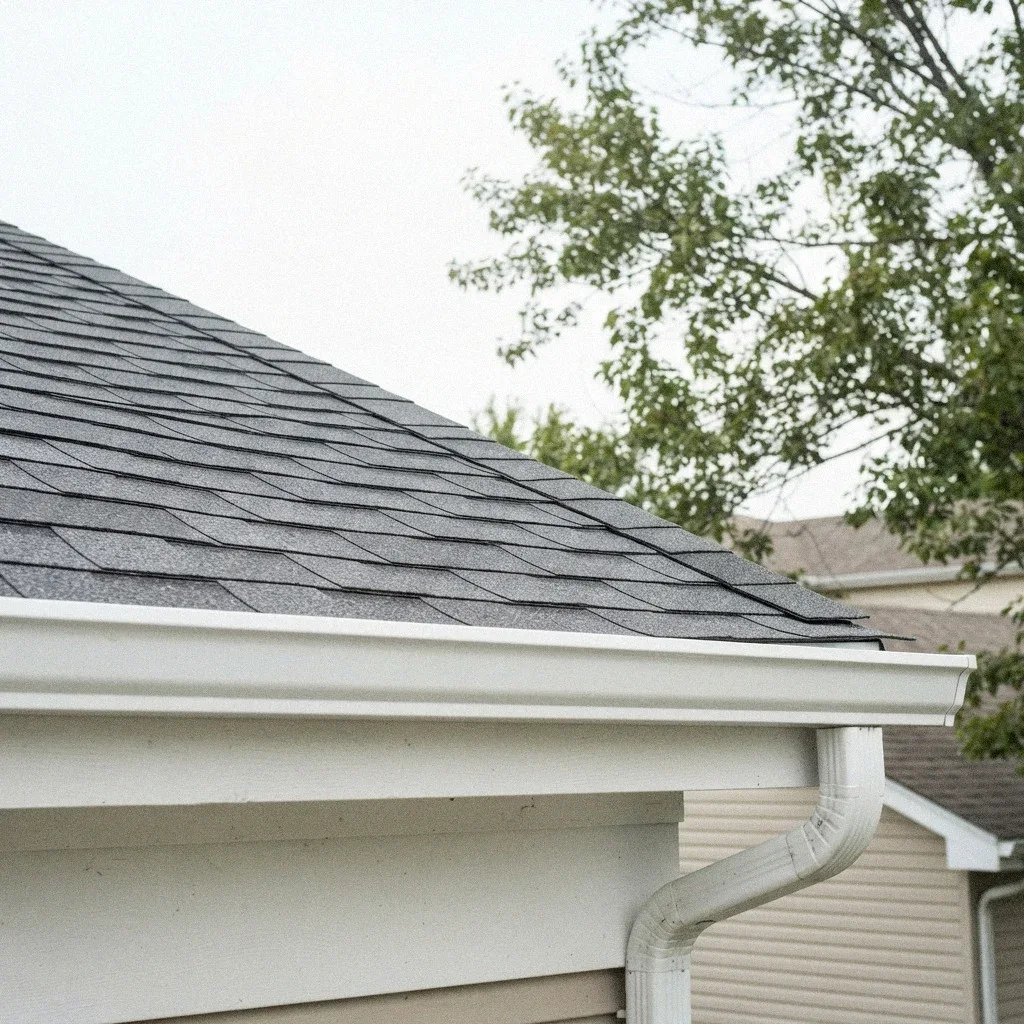
How Gutters Move Water Off a Simi Valley Roof
K-style profile, downspout count, pitch, and hardware that keep water off a Simi Valley fascia.
A properly sized Simi Valley gutter system means the right K-style profile, enough downspouts to keep runs short, correct pitch toward each outlet, sound fascia, and discharge carried well clear of the slab foundation.
Choosing a Gutter Profile and Size
Simi Valley gets its rain in bursts, not drizzle, and gutters are what stand between one of those bursts and the wall below. The Arroyo Simi channel takes the runoff once it leaves a property, but everything upstream of that channel depends on a gutter run doing its job first. Skip that step and water finds the fascia, the foundation, or the slab edge instead of the storm system it was built to reach.
Five things have to happen for a gutter system to work: water has to land inside the trough, travel to a low point, drop through a downspout, clear the building, and reach a place that won't wash back toward the house. Miss any one step and the rest doesn't matter. On a hillside parcel near Rocky Peak or Mount McCoy, the last step, getting water away from a slope, often matters more than the first four combined.
This guide treats drainage as one connected system, because a Simi Valley homeowner rarely notices a single bad part on its own. A sagging hanger near Big Sky or an undersized outlet on a Sinaloa Lake ranch home shows up later as water marks on the fascia board, not as a labeled complaint. Reading the whole chain, from roof edge to underground line, is the only way to catch a small weak point before a storm turns it into standing water.
Downspout Count and Placement
K-style and half-round are the two profiles you'll see on Simi Valley roofs. K-style has flat sides and a shaped front edge, fits standard hangers, and comes in five-inch or six-inch widths, with six-inch handling more roof area per run. Half-round is a plain curved trough, common on older or restored homes near Old Town or the Strathearn Historical Park and Museum, and it clears debris a little easier because there's no inside corner for grit to catch in.
Sizing depends on profile depth and downspout diameter together. A five-inch K-style gutter with 2-by-3-inch downspouts handles a typical single-story roof plane in neighborhoods like Berylwood or Atherwood without much trouble. Larger tile roofs, steeper pitches, or homes catching runoff from a hillside behind them in Santa Susana Knolls often need six-inch profile and 3-by-4-inch downspouts to keep up with the volume a short, hard storm can drop in an hour.
- Gutter pitch should drop about a quarter inch for every ten feet of run, angled toward the downspout outlet. On a long fascia run over a Simi Valley tract home, flat sections collect standing water and ash after a wildfire year, not just leaves.
- Hidden hangers driven into the fascia board and rafter tails carry the gutter's weight once water and dry season debris pile up. Spacing that is too wide on a Simi Valley tract roof lets the front lip droop, throwing off the gutter pitch and stalling flow toward the outlet.
- Fascia board has to be sound for hangers to hold, since they drive into the fascia and, ideally, the rafter tails behind it. On an older Simi Valley tract home, decades of valley heat can dry and crack fascia even without rot.
- Drip edge under the shingle or tile, tucked behind the gutter's back lip, sends roof runoff into the trough instead of behind it. Where it is missing or bent, water tracks down the fascia and into the wall assembly during the rare hard rain.
- Kickout flashing belongs anywhere a roof plane meets a sidewall right above a gutter end, common where additions or dormers were added to older Wood Ranch or Bridle Path homes. Without it, runoff skips the trough and soaks the wall and fascia below instead.
- Outlets should sit where the roof actually concentrates water, not just at even intervals. A valley roof line or a spot where two roof planes drain together on a Simi Valley tract home needs its own outlet, not a shared one further down the run.
Fascia Attachment and Hanger Spacing
The number of downspouts a roof needs depends on the size and shape of each roof plane feeding the gutter, not a flat rule per house. A long, straight fascia run on a Wood Ranch two-story might need two outlets just to keep pace with a hard downpour, while a broken-up roofline with several valleys, common on hillside lots toward Santa Susana, often needs an outlet near every low point so water never travels far before it drops.
Outlets are where most Simi Valley gutter systems choke first, because they are the narrowest point in the whole path and the first place a bad rain deposits leaf litter, seed pods, or ash from a nearby fire season into a tight opening. A roof edging Las Llajas Canyon or Tapo Canyon can drop enough debris in one Santa Ana wind event to pack an outlet solid, and once that happens water backs the entire run up toward the highest point instead of draining.
- A downspout extension moves discharge a few feet past the foundation using a hinged elbow onto a splash block or a straight run laid along grade. On the slab foundations common across Simi Valley tracts, skipping this step lets water pool right where it can reach the slab edge.
- An underground drain line takes water from the downspout base through a buried pipe to a discharge point away from the house, which matters on a hillside lot near Rocky Peak or Santa Susana where a slab foundation sits close to sloped ground.
- Overflow spilling over a gutter's high point usually comes from one of three things: too few downspouts sized for the roof area draining into that run, a clog sitting at the outlet, or a low spot where sag has flattened the gutter pitch until water backs up instead of moving.
- On graded lots near Rocky Peak or the hillside streets above Tapo Canyon, where a downspout releases water matters as much as gutter capacity. Water dumped too close to the slab foundation on sloped ground finds its way back toward the house instead of away from it.
Seamless Runs Versus Sectional Gutters
Gutter pitch is the slight downward angle built into a run that looks flat from the ground, dropping a small amount over each stretch toward the nearest outlet. A run pitched too flat leaves standing water that breeds debris buildup and, on a stucco tract home, stains the fascia below it. A run pitched too steep past its outlet just pushes water to the next low corner, where it overflows instead of draining the way the system was designed to.
Hidden hangers set the load limit for a gutter run, and spacing them too far apart is the most common reason a full trough sags after a Santa Ana-driven storm. These brackets sit inside the front edge and anchor into the fascia board, so their strength depends on solid wood behind them. A run holding water from a steep composition roof needs closer spacing than a light rain shadow off a low-pitch tile section over a patio.
| Gutter Style | Where It Fits | Downside |
|---|---|---|
| Seam count | Seam at every section joint | None along the run |
| Leak risk | Higher at joints | Lower over time |
| Best fit for | Cut from stock lengths | Formed on site to length |
| Repair approach | Swap the damaged section | Replace the damaged run |
| Common material | Aluminum or vinyl, stock pieces | Aluminum, formed by machine |
Signs the System Cannot Keep Up
Seamless gutter gets formed on site from a long coil of aluminum, cut to match each fascia run so joints only occur at corners and downspout outlets. That matters in Simi Valley because fewer joints mean fewer places for a leak to start after years of Santa Ana wind flexing the metal and baking the sealant. Sectional gutter uses pre-made lengths joined with connectors, which cost less upfront but give ash and debris more seams to catch on during a windy, dusty stretch.
None of it holds without solid attachment. Hangers screw into the fascia board, and the fascia board is nailed to the rafter tails underneath the roofline, so the whole run is only as strong as that hidden wood. Years of valley heat and, on shaded north-facing eaves, slower drying after a rare freeze can leave fascia soft enough that hangers pull loose under a full gutter's weight, which shows up first as a sag rather than a sudden failure.
What Santa Ana Winds Do to Gutters
At the eave, drip edge has to feed water into the gutter trough instead of letting it slip behind the fascia, and kickout flashing has to catch roof runoff at a wall-to-roof junction and turn it outward before it ever reaches the gutter at all. A kickout missing at a Simi Valley home where a lower roof meets a taller wall section sends a steady trickle straight down the siding, a problem no amount of gutter maintenance downstream will ever fix.
After the downspout, a discharge extension or splash block has to move water several feet from the foundation before it's allowed to just soak in. On the flatter lots around Tapo Canyon or the Presidential Tract, a splash block on grade is usually enough, but properties backing up toward the Santa Susana Mountains or graded hillside pads often need an underground drain line to carry water clear of a slope instead of letting it sheet across compacted fill.
Quick Checks for an Undersized System
- Five-inch K-style is the standard residential profile in Simi Valley; six-inch suits steeper or larger tile roof planes on tract homes with more roof area feeding each run.
- Seamless aluminum gutter, formed on site in one continuous run, is the standard upgrade for a full replacement across Simi Valley, since it leaves fewer seams for summer heat and wind to work loose over a tract home's life.
- A downspout extension or buried line moves water away from the slab foundation, which counts most on hillside lots near Bridle Path or Wood Ranch, where a short discharge point can send runoff straight back toward the house wall.
- Hidden hangers anchored every couple feet into fascia and rafter tails keep a run from sagging once it fills during one of the valley's short, hard winter storms rather than a steady drizzle.
- Drip edge and kickout flashing work alongside the gutter, not instead of it. Leave either one out and water tracks behind the trough into the fascia or wall assembly.
- Half-round gutter turns up on some Old Town and Santa Susana Knolls homes with older or distinct architecture; it carries less water than a same-width K-style profile and is matched with round downspouts rather than rectangular ones.
Frequently Asked Questions
What size gutters does my roof need?
Overflow along a Simi Valley fascia during a hard winter downpour usually traces to one of three things: a gutter sized too small for the roof plane above it, a pitch that stalls water instead of moving it to the outlet, or a downspout choked with leaves and ash blown in off the Santa Susana hillsides. Check the outlet screen first, then watch the gutter mid-storm to see if water sheets over the front lip or backs up behind a low spot.
How many downspouts should a roof have?
Five-inch K-style handles most Simi Valley tract roofs, but six-inch carries more water off longer planes and steeper tile roofs common around Wood Ranch and Bridle Path. Wider profile matters less here than downspout count, since our storms arrive as short, hard bursts rather than steady rain.
Should I install seamless gutters instead?
Seamless K-style gutter is formed from one coil on site, giving a fascia run with no joints besides the corners and outlets, so there are fewer spots for a leak to start over a Simi Valley driveway or walkway below.
Why does water spill over the gutter edge?
When a run has too few downspouts or too little pitch, water backs up at the high point and spills over the back edge during a hard winter storm. That overflow lands against the fascia and soaks the soil next to the slab foundation, which is the opposite of what the system is built to do.
Where should downspout water drain to?
Extend the discharge with a splash block or downspout extension so water lands several feet from the slab foundation. On hillside lots near Santa Susana or Rocky Peak, an underground drain line carrying water further downslope works better than letting it pool against the house on flatter ground.
Get Your Downspouts And Pitch Checked
Ask the licensed pros we connect you with to check your Simi Valley gutter sizing, pitch, and downspout count.
Call (805) 463-1431